
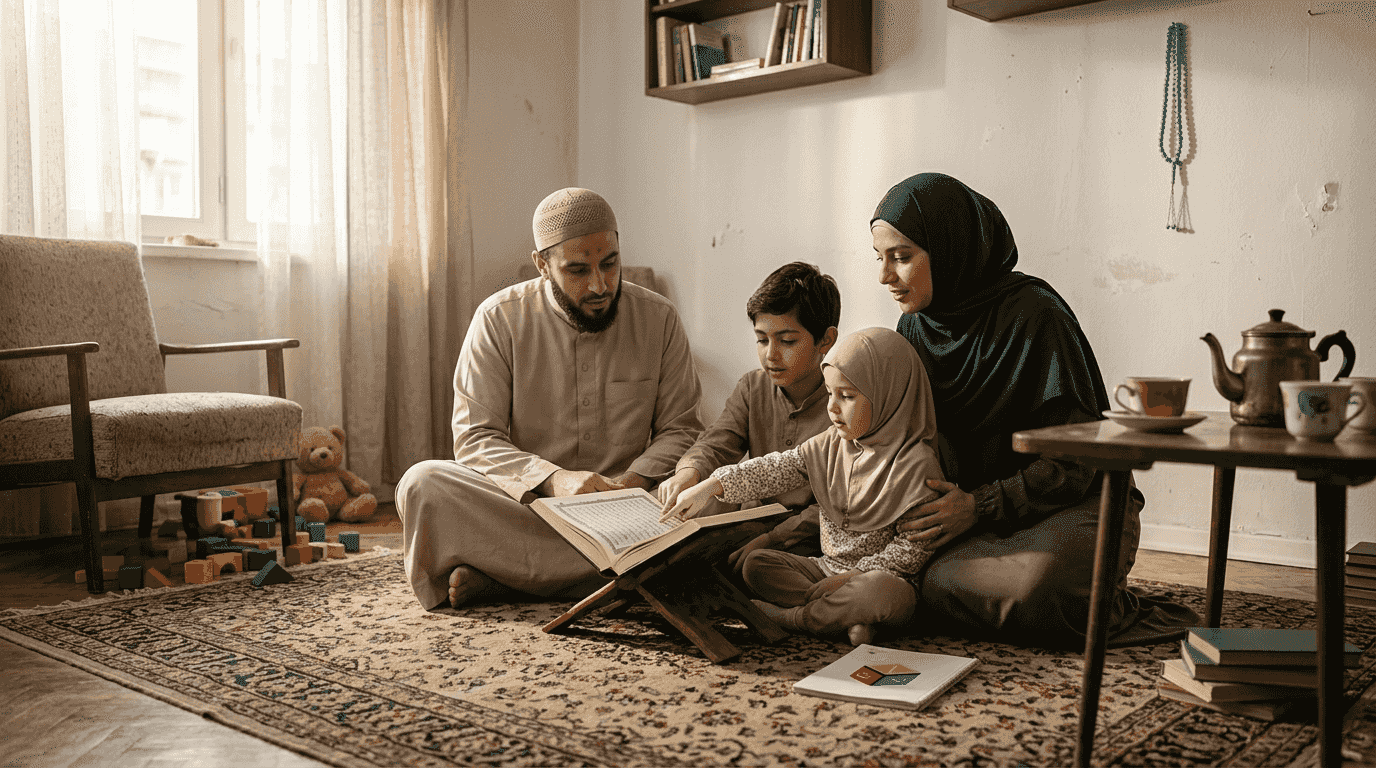
Many Muslim families treasure the Quran deeply yet struggle to weave its recitation into daily routines consistently. This gap between intention and practice isn't about lack of faith but stems from unclear strategies for integration. Understanding the Quran's transformative role in family life, personal growth, and spiritual well-being offers a pathway to meaningful engagement. This article explores how the Quran guides everyday decisions, strengthens family bonds, and provides practical frameworks for building lasting habits that honour both tradition and the demands of modern living.
Table of Contents
- Understanding The Quran's Central Role In Daily Muslim Life
- The Impact Of Quranic Guidance On Family And Personal Growth
- Cultivating Consistent Quranic Practices In Daily Routines
- The Concept Of Tarbiyah In The Quran: Nurturing Spiritual And Moral Growth
- Explore Tailored Quran Education With The Quran Hub
Key takeaways
| Point | Details |
|---|---|
| Daily recitation brings blessings | Consistent Quran reading invites divine protection and spiritual safeguarding into your home. |
| Parental modelling drives children's learning | Active involvement and motivation from parents account for nearly 80% of children's Quran reading ability. |
| Small consistent portions outperform sporadic effort | Regular brief sessions build stronger spiritual connections than infrequent lengthy readings. |
| Tarbiyah nurtures holistic development | This Quranic concept balances spiritual knowledge, ethical values, and character formation across all life stages. |
| Fixed routines automate habit formation | Linking Quran reading to existing daily activities creates reliable cues that sustain practice. |
Understanding the Quran's central role in daily Muslim life
The Quran serves as far more than historical scripture for Muslim families. It functions as a living source of blessings and divine protection when recited regularly. Prophetic traditions emphasise this protective quality, particularly regarding Sūrah al-Baqarah and Āyah al-Kursī. The Prophet Muhammad (peace be upon him) taught that reciting Ayat al-Kursi before sleep provides spiritual safeguarding throughout the night. These aren't merely symbolic gestures but practical spiritual tools that shape the atmosphere of Muslim homes.
Beyond protection, the Quran acts as a moral compass for navigating daily challenges. Its verses inspire patience when facing hardship, gratitude during blessings, and forgiveness in conflicts. These aren't abstract concepts but actionable guidance for real situations: workplace tensions, parenting struggles, financial stress, and relationship difficulties. When families engage the Quran regularly, they access frameworks for ethical decision-making that align with their deepest values.
Establishing a 'Quranic home' involves prioritising several interconnected practices:
- Regular Quran recitation by family members at consistent times
- Structured prayer routines that anchor daily schedules
- Islamic discussions during meals or family gatherings
- Reflection on Quranic verses relevant to current family situations
- Creating distraction-free spaces dedicated to spiritual activities
These elements work together to create an environment where Islamic values feel natural rather than imposed. Children absorb these practices through observation, making bringing the madrāsah to your home a realistic goal for families without local Islamic educational resources.
Reflecting on Quranic verses supports mental well-being by providing perspective during emotional turbulence. When anxiety rises, verses about trust in Allah's plan offer grounding. When anger flares, reminders about controlling one's temper provide practical intervention points. This integration of spiritual wisdom with emotional regulation creates resilience that benefits entire families.
"The best among you are those who learn the Quran and teach it." This hadith highlights that Quranic engagement isn't passive consumption but active transmission across generations.
The recitation benefits in Sahih Muslim demonstrate measurable spiritual effects. Homes where Quran recitation occurs regularly report stronger family cohesion, reduced conflict, and greater overall satisfaction. These outcomes aren't coincidental but reflect the Quran's design as a comprehensive life guide.
The impact of Quranic guidance on family and personal growth
Quranic teachings directly influence family dynamics through core values that strengthen relationships. Patience (sabr) helps parents respond thoughtfully to children's behaviour rather than react impulsively. Gratitude (shukr) shifts focus from what's lacking to appreciating present blessings, reducing household tension. Forgiveness creates space for repair after conflicts, preventing resentment from calcifying into permanent divisions. These aren't theoretical virtues but practical skills that Quranic guidance provides for daily application.
Research reveals striking evidence about parental influence on children's Quran learning. A comprehensive academic study found that Islamic parenting contributes 78% to children's Quran reading ability, with motivation adding another 1.5%. When combined, these factors account for 79.5% of the variation in children's Quranic skills. This data underscores that structured parental involvement matters far more than passive encouragement.
| Parenting Factor | Contribution to Quran Reading Ability |
|---|---|
| Parenting techniques alone | 78% |
| Motivation from parents alone | 1.5% |
| Combined techniques and motivation | 79.5% |
| Other factors | 20.5% |
These findings challenge the assumption that children will naturally develop Quran skills through occasional exposure. Instead, they require active guidance, consistent modelling, and supportive environments. Parents who recite regularly, discuss meanings during family time, and celebrate progress create conditions where children's Quran engagement flourishes.
Quranic ethics enhance marital satisfaction by aligning couples around shared spiritual beliefs. When partners approach disagreements through Quranic principles of consultation (shura) and mutual respect, they build problem-solving patterns that strengthen rather than erode their bond. This spiritual alignment creates resilience during inevitable challenges like financial stress, parenting disagreements, or extended family tensions.
Pro Tip: Create a family Quran journal where members note verses that resonated during the week and share reflections during weekend gatherings. This practice transforms individual reading into collective spiritual growth and gives children ownership of their learning journey.
Families who integrate Quranic values report improved communication patterns. Rather than avoiding difficult conversations, they develop vocabulary for discussing emotions, needs, and boundaries within an Islamic framework. This communication style reduces misunderstandings and creates emotional safety. Enrolling children in a hifdh tuition class reinforces these home practices through structured memorisation that deepens understanding.
Cultivating consistent Quranic practices in daily routines
Building sustainable Quran reading habits requires understanding how habits form. Small, daily portions create stronger neural pathways than irregular lengthy sessions. This aligns perfectly with the Islamic principle of al-dawam (perseverance). The Prophet Muhammad (peace be upon him) emphasised that consistent deeds are most beloved to Allah, even if small. This isn't about quantity but regularity, which compounds over time into profound spiritual transformation.
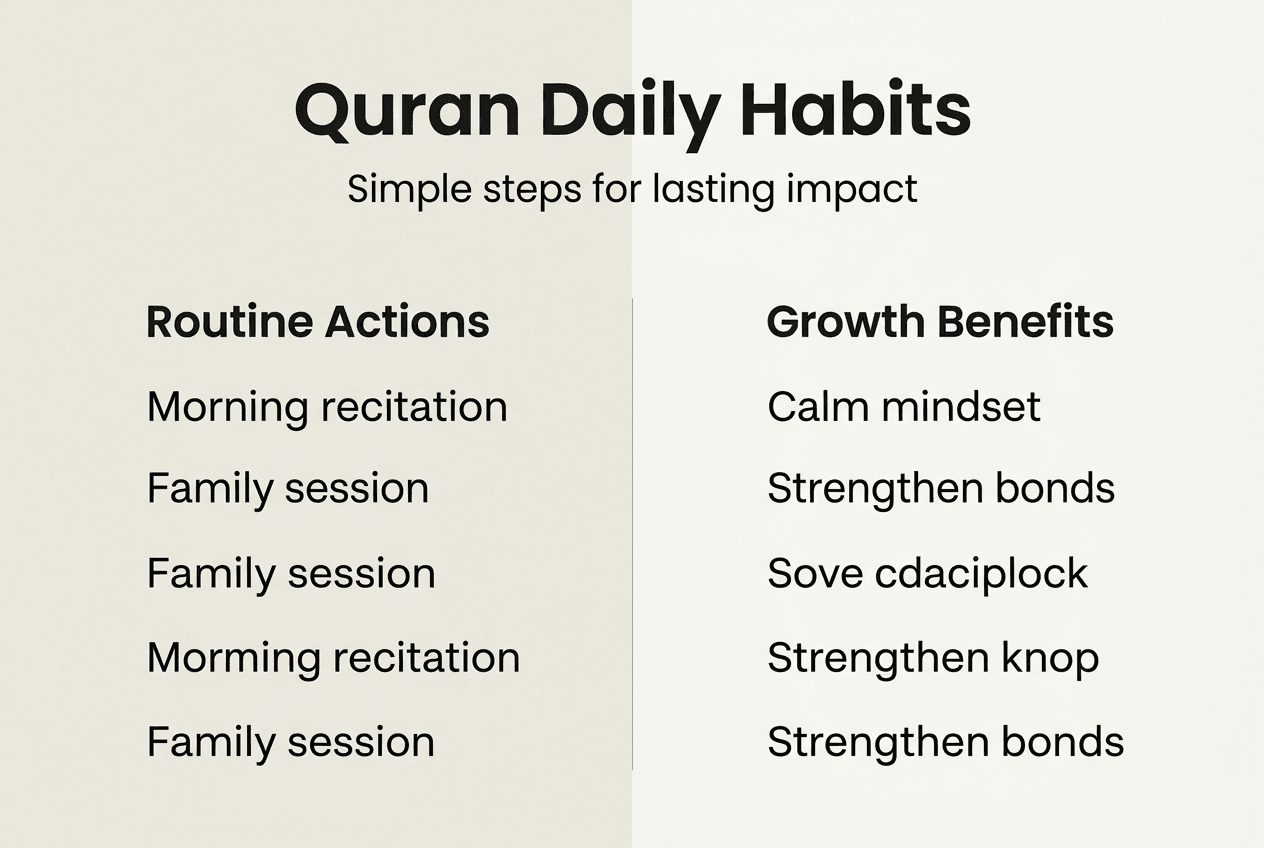
Psychological research on habit formation supports this approach. Fixed times and distraction-free places serve as environmental cues that trigger desired behaviours automatically. When you consistently read Quran after Fajr prayer in the same quiet corner, your brain begins associating that time and place with recitation. Eventually, the behaviour requires minimal willpower because it's become automatic.
Follow these steps to develop a reliable Quran reading routine:
- Choose a specific time that fits your existing schedule without requiring major adjustments
- Select a dedicated place free from phones, screens, and other interruptions
- Set a realistic duration starting with just 5-10 minutes daily
- Remove potential distractions by informing household members of your reading time
- Link the practice to an existing habit like morning prayer or evening tea
These steps leverage habit stacking, where new behaviours attach to established routines. This technique, validated by Harvard University research, dramatically increases success rates compared to relying on motivation alone.
| Practice Type | Frequency | Duration | Spiritual Connection | Habit Strength |
|---|---|---|---|---|
| Irregular reading | Sporadic, unpredictable | Long sessions when motivated | Fluctuates with mood | Weak, easily disrupted |
| Consistent reading | Daily, same time | Short, manageable portions | Steady, deepening gradually | Strong, self-sustaining |
The comparison reveals why many Muslims struggle despite sincere intentions. Sporadic effort feels productive during high-motivation periods but creates no lasting structure. When motivation inevitably wanes, the practice collapses. Consistent daily reading builds infrastructure that persists through low-motivation phases.
Pro Tip: Attach your Quran reading to an existing daily activity you never skip, like your morning coffee or post-Fajr sitting. This piggybacks on established neural pathways, making the new habit feel natural rather than forced.
Families seeking structured support can benefit from hifdh tuition class programmes that provide accountability and expert guidance. These resources complement home practices by offering systematic progression and personalised feedback that accelerates learning.
The concept of tarbiyah in the Quran: nurturing spiritual and moral growth
Tarbiyah represents a comprehensive Islamic framework for education that extends far beyond academic knowledge. The term's etymology reveals its depth: it means to educate, nurture, and develop individuals spiritually, morally, and practically. This holistic approach to development distinguishes Islamic education from purely intellectual or skills-based learning systems.
The Quran presents tarbiyah as a process guiding individuals toward deeper life purpose and stronger relationship with Allah. It's not compartmentalised into religious versus secular domains but integrates all aspects of human development. A child learning mathematics through tarbiyah doesn't just acquire calculation skills but understands numbers as signs of Allah's precise creation. This integration creates coherent worldviews rather than fragmented knowledge.
Tarbiyah involves joint responsibility across multiple spheres:
- Parents providing foundational spiritual knowledge and ethical modelling at home
- Community members reinforcing Islamic values through social interactions and support
- Educational institutions offering structured curricula that develop skills systematically
- Individual learners taking ownership of their spiritual journey and character refinement
- Society creating environments that support rather than undermine Islamic principles
These components work synergistically. When parents model Quranic values but community norms contradict them, children receive mixed messages that create confusion. When educational systems teach Islamic content but families don't practise it, knowledge remains abstract rather than lived. Tarbiyah requires alignment across all these domains.
The process balances physical and spiritual development, recognising humans as integrated beings. Neglecting physical health undermines spiritual capacity, whilst ignoring spiritual needs leaves material success feeling hollow. Tarbiyah cultivates both dimensions simultaneously, creating balanced individuals capable of contributing meaningfully to family and society.
Tarbiyah's universality makes it applicable across ages and cultures. A toddler learning basic manners, a teenager navigating peer pressure, and an adult facing career decisions all benefit from tarbiyah's principles. This adaptability stems from grounding in timeless Quranic wisdom rather than culturally specific practices. Families can access this framework through resources like bringing the madrāsah to your home, which provide structured guidance for implementing tarbiyah principles.
The Islamic way of tarbiyah encompasses multiple types: spiritual tarbiyah focusing on faith development, moral tarbiyah building character, intellectual tarbiyah cultivating knowledge, and social tarbiyah fostering community responsibility. This multifaceted approach ensures no dimension of human potential remains underdeveloped.
Explore tailored Quran education with the Quran Hub
Transforming these insights into practice becomes easier with expert support. The Quran Hub offers structured programmes designed specifically for Muslim families seeking to deepen their Quranic engagement without compromising on quality or flexibility.
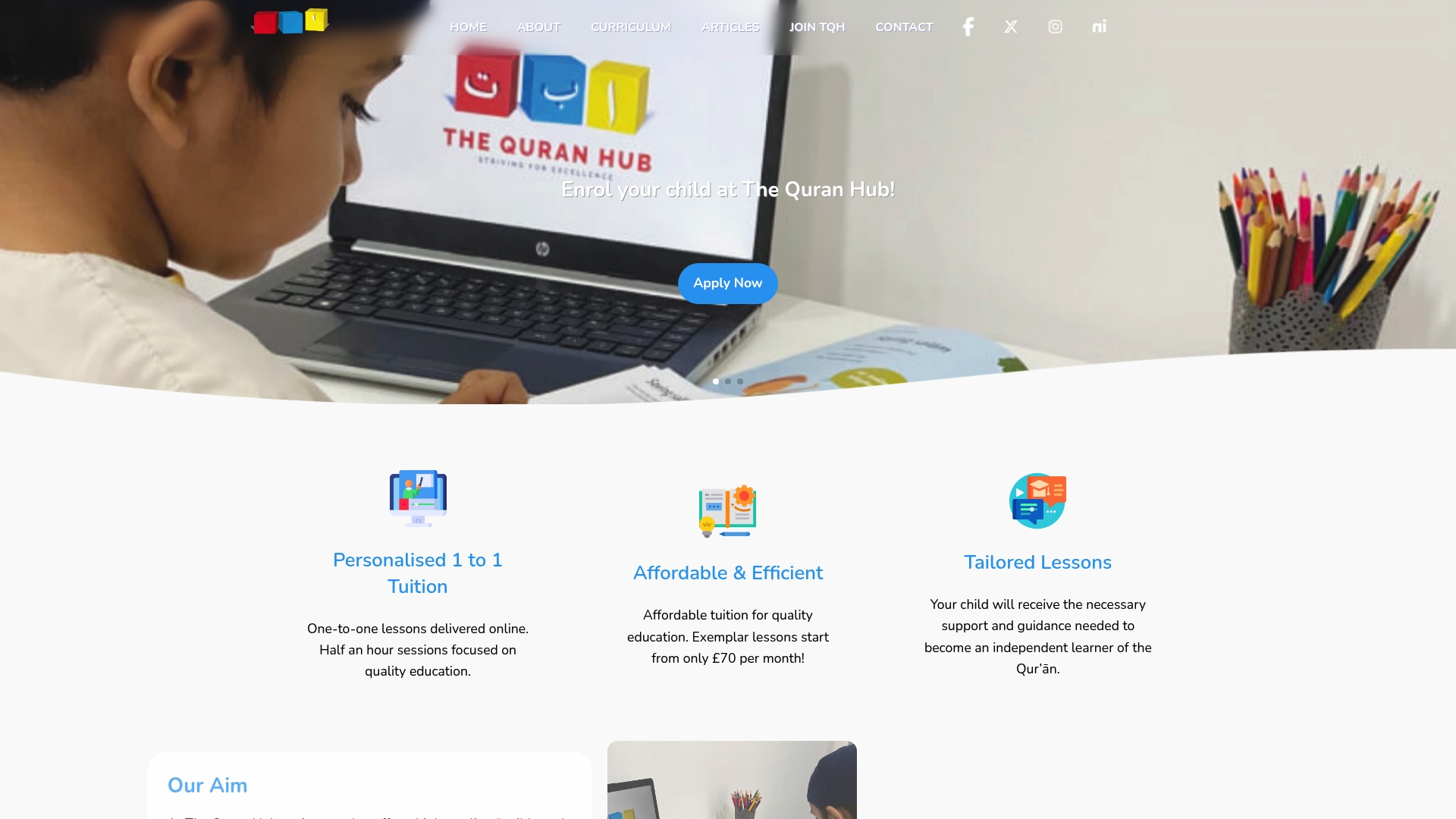
Our hifdh tuition class provides personalised memorisation support that adapts to each student's pace and learning style. Experienced tutors understand the challenges families face and create sustainable progression plans that build confidence alongside competence. The Quran Hub curriculum balances spiritual development with academic rigour, nurturing the holistic growth that tarbiyah principles emphasise. Our qualified tutors bring both Islamic scholarship and teaching expertise, ensuring students receive authentic knowledge delivered through effective pedagogical methods. Starting Quran education early with professional guidance establishes foundations that support lifelong learning and spiritual growth.
FAQ
How often should I recite the Quran daily to see benefits?
Even brief daily portions create stronger spiritual connections than irregular lengthy sessions. The Prophet Muhammad (peace be upon him) taught that consistent small deeds are most beloved to Allah, emphasising regularity over quantity. Starting with just 5-10 minutes daily builds sustainable habits that compound into profound transformation over months and years.
How can parents encourage children to develop Quran reading habits?
Active parental involvement makes the decisive difference. Research shows that parenting techniques combined with motivation account for 79.5% of children's Quran reading ability. Model consistent recitation yourself, create dedicated family reading times, celebrate progress genuinely, and provide structured support through resources like bringing the madrāsah to your home. Children absorb values through observation far more than instruction.
What is the significance of tarbiyah in Quranic education?
Tarbiyah represents comprehensive nurturing encompassing spiritual knowledge, ethical values, character formation, and social responsibility. This holistic development approach distinguishes Islamic education by integrating all life dimensions rather than separating religious from secular learning. It aims to cultivate balanced individuals with strong faith, sound character, and practical skills who contribute meaningfully to family and community.
Which Quranic verses provide the most protection for homes?
Sūrah al-Baqarah and Āyah al-Kursī hold special significance for spiritual protection. The Prophet Muhammad (peace be upon him) specifically mentioned that reciting Ayat al-Kursi before sleep provides divine safeguarding throughout the night. Regular recitation of these passages creates an atmosphere of blessing and protection that families consistently report experiencing in their homes.