

Finding time to teach your children proper Quran recitation can feel overwhelming when juggling work, school runs, and family commitments across the UK. Many Muslim parents worry their children won't develop accurate tajweed or deep understanding without consistent, expert guidance. Online Quran tuition offers a solution: flexible, personalised lessons that fit your schedule whilst delivering measurable improvements in recitation and comprehension. This guide provides a proven workflow to help your family succeed with accessible, structured Quran reading education from home.
Table of Contents
- Preparing For Your Child's Quran Reading Journey
- Step By Step Workflow For Effective Quran Reading Online
- Common Tajweed Mistakes And How To Correct Them Early
- Monitoring Progress And Ensuring Lasting Improvement
- Personalised Online Quran Tuition At The Quran Hub
- How Can Online Quran Tuition Fit Into A Busy Family Schedule?
- What If My Child Is Struggling With Tajweed Rules Despite Practice?
- How Do I Choose The Right Online Quran Tutor For My Child?
- Can My Child Still Progress If We Miss Some Online Lessons?
Key takeaways
| Point | Details |
|---|---|
| Flexible scheduling | Recorded lessons and adaptable timetables support busy UK Muslim families' varied routines and commitments. |
| Personalised instruction | Certified teachers with Ijāzah deliver tailored tuition producing 60-70% improvement in recitation within three months. |
| Early error correction | Common tajweed mistakes can critically alter meanings and require prompt professional intervention to prevent lifelong bad habits. |
| Progress monitoring | Regular feedback sessions and recorded playback enable parents to verify learning outcomes and maintain motivation. |
| Accessible expertise | Online platforms bring qualified Quran teachers to homes lacking local madrasahs or mosques across the UK. |
Preparing for your child's Quran reading journey
Before launching into online tuition, establish clear foundations. Identify your child's specific learning goals: do you prioritise fluent recitation, precise tajweed application, or deeper understanding of meanings? Each objective shapes the teaching approach and curriculum focus.
Teacher qualifications matter profoundly. Parents show a 90% preference for Quran teachers holding Ijāzah certification, which authenticates their authority to transmit Quranic knowledge through an unbroken chain back to the Prophet Muhammad (peace be upon him). This credential ensures your child receives accurate, trusted instruction rather than well-meaning but potentially flawed guidance.
Scheduling flexibility ranks as the top priority for UK families. Research indicates 75% of Muslim parents prioritise flexible scheduling when selecting online Quran tuition. Consider your child's energy patterns: are they alert early morning before school, or more focused after tea? Online platforms accommodate these preferences whilst bringing the madrasah online directly to your living room.
Prepare a dedicated study environment. Your child needs a quiet, modest space free from distractions, with reliable internet connectivity and a device supporting video calls. A tablet or laptop works well, positioned at eye level to maintain proper posture during recitation.
Pro Tip: Request sample recordings from prospective teachers to assess their tajweed accuracy and teaching style before committing to lessons.
Prerequisites for starting online Quran tuition
| Requirement | Details | Priority Level |
|---|---|---|
| Teacher Ijāzah | Authentic certification in Quran recitation | Essential |
| Internet connection | Stable broadband, minimum 10 Mbps | Essential |
| Quiet study space | Distraction-free area with good lighting | High |
| Device access | Tablet, laptop, or desktop with camera | Essential |
| Flexible scheduling | Platform offering varied lesson times | High |
| Recorded sessions | Ability to review lessons afterwards | Recommended |
Ensure your chosen platform provides access to certified Quran teachers who understand children's developmental needs. Younger students benefit from shorter, engaging sessions with visual aids, whilst older learners can manage longer periods of concentrated study.
Step by step workflow for effective Quran reading online
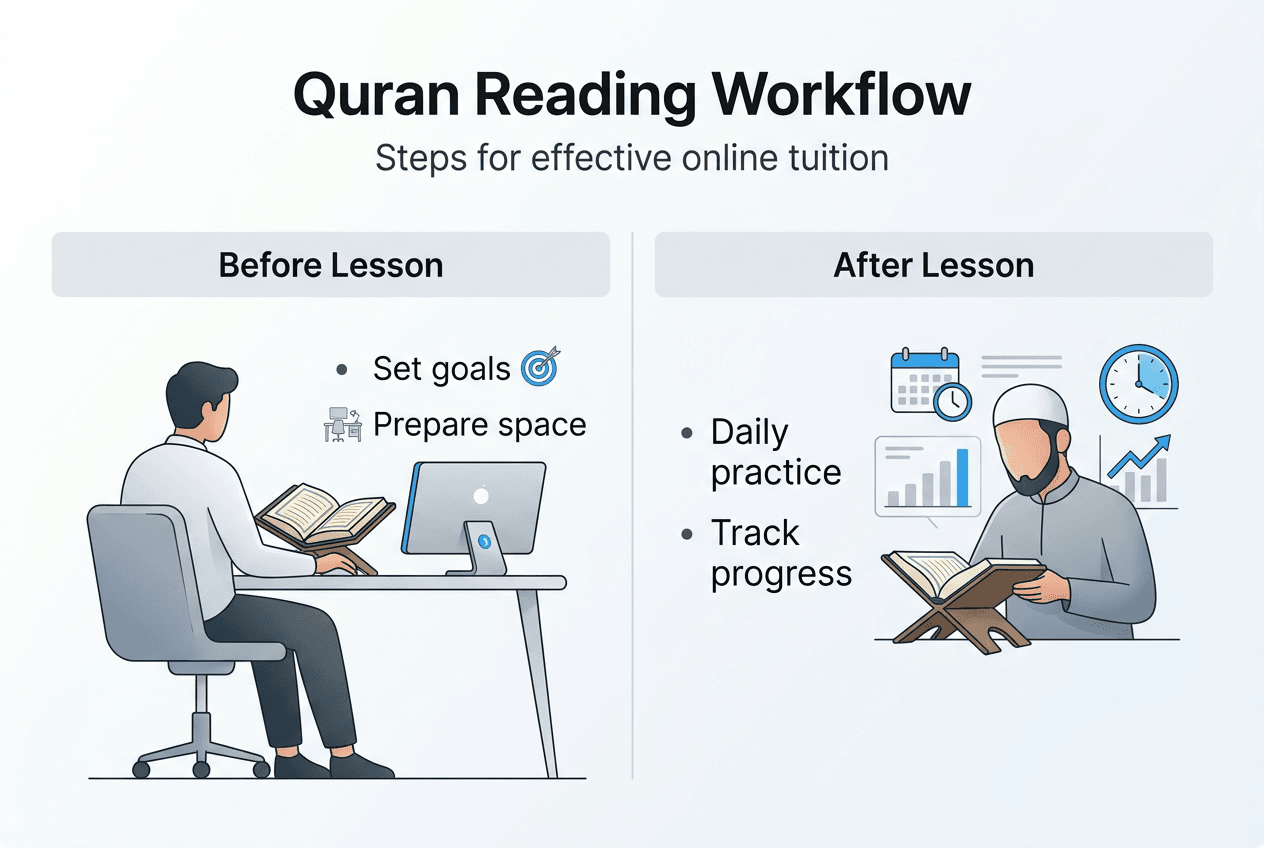
Establishing a consistent routine maximises learning outcomes. Follow this proven workflow to structure your child's online Quran education effectively.
Before each lesson
- Review the previous session's notes and any corrections highlighted by the teacher.
- Listen to recorded audio from the last lesson, identifying areas your child found challenging.
- Practise those difficult sections together for 10-15 minutes, focusing on proper letter pronunciation.
- Prepare any questions about tajweed rules or meanings to ask during the upcoming session.
- Ensure the study space is ready with the device charged and internet tested.
Schedule lessons when your child demonstrates peak alertness. Morning sessions suit some families, whilst others find late afternoon works better after school and homework completion. The beauty of online tuition lies in this adaptability to your unique timetable.
During live sessions, encourage your child to engage actively. They should repeat verses multiple times, applying tajweed corrections immediately. Teachers trained in the online Quran curriculum use interactive techniques keeping young learners focused and motivated.

Studies demonstrate 60-70% improvement in recitation accuracy and comprehension with personalised online classes within three months. This dramatic progress stems from individualised attention impossible in large group settings.
After each lesson
- Review the session recording within 24 hours whilst details remain fresh
- Practise new verses daily for at least 15 minutes using proper tajweed rules
- Note specific challenges in a progress journal for discussion next lesson
- Celebrate small victories to maintain enthusiasm and confidence
Consistent daily practice between sessions proves crucial. Even 15 focused minutes outperforms sporadic longer sessions. The madrasah at home model succeeds when parents actively support this routine.
Pro Tip: Create a simple chart tracking verses mastered each week. Visual progress motivates children and helps identify when additional practice sessions might benefit specific surahs.
Common tajweed mistakes and how to correct them early
Tajweed errors range from minor pronunciation issues to critical mistakes altering Quranic meanings. Understanding these pitfalls helps you support your child's accurate learning journey.
Tajweed mistake severity comparison
| Mistake Type | Example | Impact on Meaning | Correction Timeline |
|---|---|---|---|
| Letter confusion | Mixing ق (qaf) and ك (kaf) | Critical change | 2-4 weeks |
| Vowel length | Shortening madd (elongation) | Moderate distortion | 3-6 weeks |
| Ghunnah omission | Skipping nasal sound on ن or م | Minor quality issue | 2-3 weeks |
| Qalqalah weakness | Insufficient echoing on specific letters | Recitation quality | 4-6 weeks |
| Idghaam errors | Incorrect merging of letters | Meaning alteration | 3-5 weeks |
Critical mistakes demand immediate attention. Confusing ق (qaf) and ك (kaf) fundamentally changes word meanings, potentially altering the message entirely. Similarly, incorrect vowel lengths or letter merging can shift interpretations.
Warning: Some tajweed errors don't just affect recitation beauty but actually change the Quran's meanings. Early professional correction prevents these mistakes becoming ingrained habits that take months to unlearn.
Qualified teachers spot these errors instantly. Their expertise in tajweed correction tuition ensures your child learns proper articulation from the start rather than spending months later correcting bad habits.
Research shows correcting established bad tajweed habits typically requires 2-6 months with proper guidance. Prevention through accurate initial teaching proves far more efficient than later remediation.
Common correction strategies
- Record your child's recitation and compare it to their teacher's model
- Practise problematic letters in isolation before incorporating them into verses
- Use mirror exercises to observe mouth and tongue positioning
- Break challenging words into syllables, mastering each component separately
- Request additional focus on specific tajweed rules during lessons
Children's brains absorb correct patterns rapidly when taught properly from the beginning. This neuroplasticity advantage makes early childhood the ideal time for tajweed mastery, but students of any age benefit from expert instruction.
Monitoring progress and ensuring lasting improvement
Verifying your child's advancement requires structured assessment beyond simply completing more verses. Implement these monitoring strategies to ensure genuine, lasting learning.
Establish monthly feedback sessions with your child's tutor. Discuss specific strengths, persistent challenges, and adjusted learning objectives. Teachers provide professional insights you might miss, identifying subtle pronunciation issues or comprehension gaps requiring attention.
Recorded session playback serves multiple purposes. You can assess progress by comparing recordings from different months, hearing improvements in fluency and accuracy. Your child benefits from self-assessment, developing critical listening skills essential for independent Quran study.
Goal setting framework
- Set short-term weekly targets: master three new verses with correct tajweed
- Establish monthly objectives: complete one full surah with 90% accuracy
- Define long-term goals: achieve fluent recitation of Juz Amma within six months
- Celebrate milestones with meaningful rewards reinforcing Islamic values
- Adjust targets based on actual progress rather than rigid timelines
Platform data reveals an 80% satisfaction rate amongst users benefiting from flexible scheduling and recorded lesson access, leading to consistent learning outcomes. This flexibility prevents the frustration of missed progress when life inevitably disrupts rigid schedules.
Signs of successful learning
- Your child recites confidently without frequent hesitation or self-correction
- They identify and explain tajweed rules when reading new verses
- Pronunciation of challenging letters shows consistent accuracy
- They demonstrate enthusiasm for lessons and voluntary practice
- Comprehension questions reveal genuine understanding beyond rote memorisation
If progress stalls despite consistent effort, don't hesitate to request additional assessment. Sometimes learning plateaus indicate the need for curriculum adjustment or teaching approach modification rather than student deficiency.
Maintaining motivation proves crucial for long-term success. Acknowledge effort alongside achievement. A child struggling with a difficult surah who practises diligently deserves recognition equal to one who masters verses easily.
Pro Tip: Keep a voice recording archive starting from your child's first lessons. Playing these recordings months later provides powerful motivation by demonstrating how far they've progressed.
Consider applying for Quran tuition that includes regular progress reports and parent consultations. Transparent communication between teachers and families creates the supportive environment children need to thrive.
Personalised online Quran tuition at the Quran Hub
The Quran Hub delivers exactly what busy UK Muslim families need: flexible scheduling, certified teachers, and personalised learning plans that produce measurable results. Our tutors hold authentic Ijāzah certification and specialise in making Quran education engaging for children of all ages.
Explore our online hifdh tuition classes designed around your family's schedule, with recorded sessions available for review anytime. Meet our certified tutors and discover how personalised attention transforms Quran learning from a chore into a cherished daily practice. Ready to begin? Apply for Quran tuition today and request an initial assessment to tailor your child's learning journey.
Pro Tip: Request a trial lesson focusing on your child's current level to experience how personalised instruction addresses their specific needs before committing to a full programme.
How can online Quran tuition fit into a busy family schedule?
How does flexible scheduling work with online Quran lessons?
Online platforms offer lesson times throughout the day and evening, accommodating school schedules, work commitments, and family activities. You choose slots that suit your child's energy levels and your household routine. Recorded sessions mean missed live lessons don't result in lost learning, as your child can review content anytime. This flexibility proves essential for families juggling multiple children's activities or parents working irregular hours.
Can shorter, more frequent sessions work as well as longer weekly lessons?
Personalised tuition maximises every minute, making 30-minute focused sessions three times weekly often more effective than single 90-minute blocks. Children maintain concentration better during shorter periods, and frequent exposure reinforces learning more effectively than sporadic longer sessions. Teachers adapt pacing to your child's attention span and learning style, ensuring productive use of available time.
What technology do certified teachers use to teach effectively online?
Qualified instructors employ interactive whiteboards for demonstrating tajweed rules, screen sharing for following along with digital Quran texts, and high-quality audio for precise pronunciation modelling. Many use visual aids and engaging activities keeping young learners focused. The technology enhances rather than replaces traditional teaching methods, bringing the madrasah online without sacrificing educational quality.
How do I know my child is actually learning and not just attending sessions?
Recorded lessons allow you to observe teaching quality and your child's participation directly. Regular assessments and progress reports provide objective measures of advancement. Most importantly, you'll hear improvements in your child's recitation during family prayers and daily practice, demonstrating genuine skill development beyond mere attendance.
What if my child is struggling with tajweed rules despite practice?
Is it normal for children to find tajweed challenging initially?
Absolutely. Tajweed requires training muscles and developing auditory discrimination many children haven't previously used. Initial struggles with letter articulation or vowel lengths are completely normal and expected. The key lies in consistent, expert guidance preventing these early challenges from becoming permanent bad habits. Correcting established bad tajweed habits typically requires 2-6 months with proper instruction, whilst learning correctly from the start avoids this remediation period entirely.
When should I seek additional help for persistent tajweed difficulties?
If your child shows no improvement after four to six weeks of consistent practice and instruction, discuss concerns with their tutor. Sometimes a different teaching approach, additional practice exercises, or more frequent shorter sessions resolve the issue. Qualified teachers at platforms offering tajweed correction tuition can identify specific articulation challenges and provide targeted exercises addressing them.
How can I support my child's tajweed learning at home?
Practise alongside them, even if your own tajweed needs improvement. Listen to professional reciters together, discussing the tajweed rules being applied. Encourage your child to teach you what they've learned, as explaining concepts reinforces their own understanding. Avoid criticising mistakes harshly, instead celebrating incremental progress and maintaining enthusiasm for learning.
How do I choose the right online Quran tutor for my child?
What qualifications should I look for in a Quran teacher?
Prioritise tutors holding authentic Ijāzah certification in Quran recitation, demonstrating their authority to teach through an unbroken chain of transmission. Research shows 90% of parents prefer teachers with Ijāzah certification for the confidence and authenticity it provides. Additionally, seek teachers with experience working specifically with children, as pedagogical skills matter alongside Quranic knowledge.
How important is teaching style compatibility?
Extremely important for long-term success. Some children respond well to structured, formal instruction whilst others thrive with more playful, interactive approaches. Request trial lessons with potential tutors to assess whether their personality and methods suit your child's learning preferences. The certified Quran teachers who connect personally with students produce far better outcomes than even highly qualified instructors whose style doesn't resonate.
Should the tutor offer flexible rescheduling options?
Flexibility proves essential for busy families. Life inevitably brings illness, family events, or unexpected commitments disrupting regular schedules. Teachers and platforms accommodating reasonable rescheduling requests with recorded session access ensure consistent learning despite occasional disruptions. This adaptability prevents the frustration and guilt that rigid scheduling often creates for parents already managing complex family logistics.
Can my child still progress if we miss some online lessons?
How do recorded lessons help when we miss live sessions?
Recorded lessons provide complete coverage of missed content, allowing your child to learn the material on their own schedule. They can pause, rewind, and replay challenging sections multiple times, often leading to deeper understanding than single live exposure. Platform data shows an 80% satisfaction rate amongst families using flexible scheduling and recorded lessons, demonstrating this approach supports consistent learning despite occasional absences.
What happens if we need to reschedule frequently?
Reputable platforms and tutors understand family life's unpredictability and accommodate reasonable rescheduling requests. However, excessive changes can disrupt learning momentum and teacher-student relationship building. Aim for consistency where possible, using recorded sessions to bridge gaps when rescheduling proves necessary. Our flexible Quran hifdh classes balance accommodation with structure, helping families maintain productive learning rhythms.
How can parents help maintain routine despite missed sessions?
Establish daily practice habits independent of scheduled lessons. Even 10 minutes reviewing previous material keeps skills sharp during gaps between sessions. Use recorded lessons proactively rather than reactively, watching them together as family learning time. Your involvement demonstrates that Quran education remains a priority despite schedule disruptions, modelling the commitment you want your child to develop.